today + five questions with julie morstad

What will today bring?  In her latest book TODAY, in her natural and effortless way, Julie Morstad shows us the beauty of the quotidian, its moments of whimsy and its potential to surprise us with something extraordinary.  But how?  She helps us revel in the possibilities of today.  What should we wear?  What should we eat for breakfast?  Porridge or pizza?  Where should we go?  For a walk in the woods or to the museum?  How will we get there?  By bike or dancing our way there?  She reminds us that each day is remarkable in its own right.

Julie's work resonates with children and adults alike.  Hers are the stories full of wonder that you read to your kids at bedtime and are the same ones that you want to sit down with on your own and linger over, during those last quiet moments of the long day, well after your kids have drifted off to sleep.

Julie graciously stopped by to chat for a bit and answer five questions for us.


How do you come up with ideas for the books that you author and illustrate?

A lot of ideas come from my kids and the other kids I know.  The way they see things.  I also get inspired by everyday things like leaves on the ground, or the moon … random thoughts, art and textiles.


Which illustrators or artists have most influenced your work? 

How can i choose?  Hmm....Alice and Martin Provensen, Gyo Fujikawa, Kenojuak Ashevak, Maurice Sendak, Remy Charlip, Roger Duvoisin, Miroslav Sasek, Ingrid Vang Nyman, Tove Jansson, Evaline Ness, Sonia Delaunay, Saul Steinberg, Paul Klee, Tomi Ungerer, my kids’ drawings.


What drew you to illustrating picture books?

I have alway loved picture books as a medium.  I had a son quite young and we spent a lot of time at the library.  I learned a lot about illustrators by hunting through the library sale tables…treasure!!


What’s a day in the life like for you?

1. Get the kids to school 

2. Get down to work!  I work from home so I have to try hard to stay focused in my house!


Any new projects that you're working on that you can tell us about?

I’m working on a new book with Kyo Maclear (we made Julia, Child together).  It's a picture book bio about Elsa Schiaparelli, the great 20th century fashion designer.  It's super fun.


Thank you, Julie, for stopping by!  You can see Julie’s beautiful work on her site and keep up with her latest on Instagram.

who built that? bridges

It's amazing to consider the significant role bridges play in connecting people.  They are part of what makes travel possible.  In the third installment of the Who Built That? series published by Princeton Architecture Press, designer/illustrator Didier Cornille explores ten of the world’s most important bridges including the Brooklyn Bridge in New York City, the Iron Bridge in Shropshire, the Golden Gate Bridge in San Francisco and the Peace Bridge in Calgary.  He introduces the engineers and architects behind these innovative structures and their main design and engineering concepts.  He also includes the bridges' narratives—some history, background and stories about the building process—which are fascinating and make for a more meaningful experience for the reader.

One more piece of exciting news.  Princeton Architectural Press is offering 35% off on their books and free shipping with the code FRIENDS until 12/5, so be sure to check out their Who Built That? series and their diverse collection of art books.

The Cat Who Came In Off The Roof

The Cat Who Came In Off The Roof | Avery and Augustine

Tibble, a shy and hapless cat-loving reporter, almost loses his job due to writing too many stories about cats.  Things change when he meets Minou, a woman whom he rescues from a tree one night.  Strangely enough, she possesses cat-like qualities—she's extremely agile, is able to to climb trees with ease and has a tremendous fear of dogs.  She turns things around for his career because she somehow has the inside scoop on the news around town.  We've only just started reading The Cat Who Came in off the Roof and it's a pretty intriguing story so far.

The Cat Who Came in off the Roof was originally written in 1970 by beloved Dutch children’s author Annie M. G. Schmidt.  This edition is a reprint published earlier this year by Delacorte Press.

Be sure to check out what @the.book.report is sharing for this week's #classicchapterbooks.

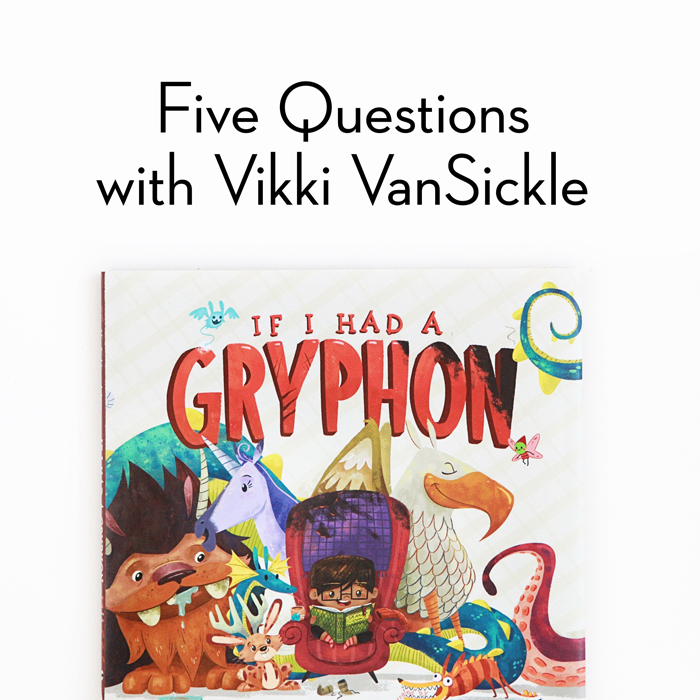
five questions with vikki vansickle


Vikki VanSickle stops by today to answer five questions about the writing process for If I Had a Gryphon, what brought her to children’s publishing and more.  If I Had a Gryphon was published earlier this year and was illustrated by Cale Atkinson.


What was the writing process like for If I Had a Gryphon and how long did it take from idea to publication?

The spark came while I was working at The Flying Dragon Bookshop in Toronto in 2009. I sat in on a lot of storytimes and fell (more) in love with picture books. I really wanted to write one, but I was a bit stuck when it came to ideas. I had written a few middle grade novels, but picture books were new and daunting. At the time, Harry Potter was king and I noticed a lot of younger children wanted storybooks that were Harry Potter-esque, but most of what I could find (Dragonology, Mythology, How to Train Your Dragon) were for older readers or only featured the standard beasts (dragons, unicorns, monsters). These things were all percolating in my head and I decided to write an introduction to magical and mythological creatures for the very young. 

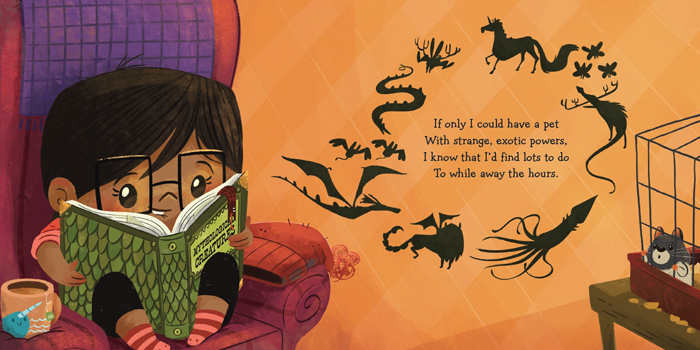
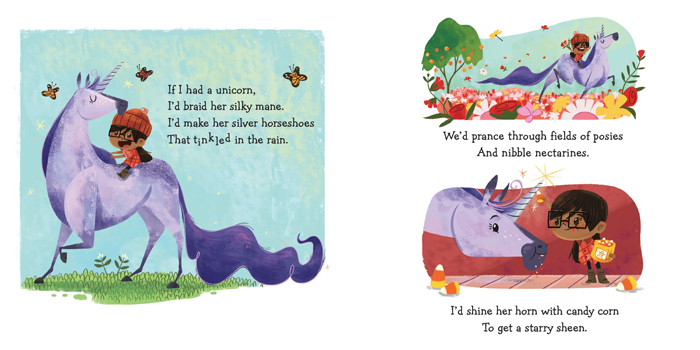
The first draft was essentially a list poem, with a little girl listing magical pet options and how she would look after them in order to convince her father. It was very sweet and fun to write, but it didn't have a great sense of urgency. As I thought about it I realized how challenging it would be to look after some of the creatures. With some advice from a dear writing friend and my agent, I re-ordered the list from low-maintenance to high maintenance to increase the tension from a content perspective.  In terms of structure, I re-wrote it so the dedicated-creature stanzas got shorter and shorter until the last section, in which there's  a new creature every line. This crescendos nicely and gives a sense of chaos. The book is a more fun and has a lot more drive now. 

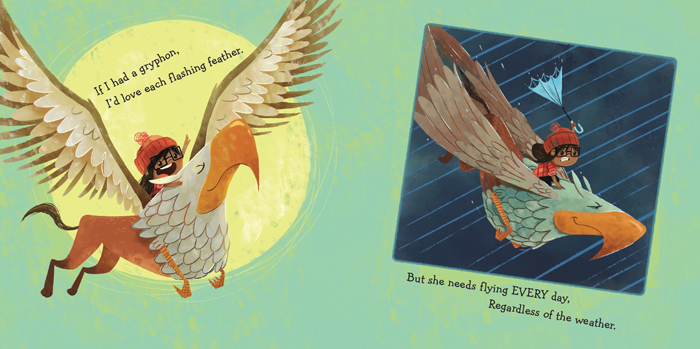
A number of publishers considered the manuscript, but it wasn't contracted until 2013. Some editors liked the story, but did not like the rhyme. I tried to rewrite it in prose but it didn't feel right to me, it lost some of its magic. Tundra Books had no problem with the rhyme, which was as sign that Gryphon had found the right home. I was thrilled when Cale Atkinson agreed to illustrate. Some of the creatures are historically quite scary, but in his capable hands they were fun, gregarious, and downright cuddly! It is such a privilege to have an artist interpret your words and I could not be more thrilled with the final product. 


What brought you to the world of children’s publishing?

Reading has been the most transformative force in my life. Working in children's publishing, I get to be part of creating the books that will have an impact on another generation.  I've been lucky enough to try many avenues in the wonderful world of children's books. I've worked in a public library as the children's summer programmer, managed an independent children's book store, reviewed kids' books for Canadian literary periodicals, and eventually landed in publishing, all the while writing up a storm. I have loved all of these jobs and have learned valuable things in each one. 


What kinds of books were you drawn to as a child?

I read anything and everything, but I especially liked books featuring cats. A Rose for Pinkerton and Catwings were two favourites. We also had an anthology of poetry that I read over and over again. I loved how a single poem on a single page could contain a whole world. I was mystified that so few words could inspire such big, expansive images in my head. Eventually I became a total mystery nut. I blame it on the fantastic Miss Nelson is Missing, which was the first mystery story I ever read. As I got older I graduated to Nancy Drew. I still love a good mystery! 


What other career avenues do you think you would have pursued if you didn’t work in publishing?

I had intended to be a playwright before I got (happily) sidetracked by children's literature. I also considered teaching or librarianship, as they combined working with books and children, two of my favourite things. Lately I've been fascinated by political speechwriting. I love how mere words can shape ideas and create change. I think it's safe to say that whatever industry I ended up in, there was bound to be a book or writing-related component! 

We loved chatting with you, Vikki, and many thanks for stopping by.  Be sure to check out Vikki’s blog and keep up with her latest on Instagram and Twitter.


How Cities Work

How Cities Work | Avery and Augustine

An introduction to the inner workings of a city with fold-out pages and flaps that reveal structures beneath them like underground railroads and the digging of a new tunnel.  Kids get a peek at what goes on inside city hall and the latest show at the opera house.  The pages display many aspects of city life: transportation, various types of urban living, construction and building projects, skyscrapers, green spaces, underground infrastructure, city hall, emergency services, recreation, culture and nocturnal goings-on.  There's a feature at the end about cities of the future.

How Cities Work is a great lesson that will get children thinking about all that goes into urban planning and the scores of people it takes to build something as big, complex and expansive as a city.  How Cities Work is by James Gulliver Hancock and Jen Feroze.  Published by Lonely Planet.